


A good backyard doesn't clock off when the sun goes down. This guide covers every type of garden lighting worth considering in Australia, what each one actually does well, and how to set it all up without rewiring the house or spending a weekend up a ladder.
- Why garden lighting is worth it
- The main types of garden lights
- The one-plug option: garden laser projectors
- Quick comparison: which light does what
- Choosing fixtures that last
- Placement and installation
- Making the most of your space after dark
- Keeping your lights in good nick
- Garden lighting FAQ
Why garden lighting is worth it
Most backyards do their best work between breakfast and dinner, then disappear into the dark. A bit of well-placed lighting hands those lost hours back. The deck becomes somewhere to eat, the lawn stays in play after tea, and the garden you spent all winter on actually gets seen.
There are three solid reasons to light a garden, and only one of them is about looks:
- You get more use out of the space. We spend serious money on outdoor areas, then mostly look at them through a window at night. Lighting stretches barbecues, dinners and lazy drinks well past sunset, especially in summer when the evening is the best part of the day.
- It makes the place safer. Steps, path edges, the hose someone left out: all trip hazards once the light drops. Soft, consistent lighting along walkways and stairs sorts most of that out for guests and family alike.
- It quietly boosts security. A lit yard is a far less inviting yard to wander into. Motion-sensor floods near side gates and back doors remove the shadows where someone could stand unseen, and a timer or two makes the house look occupied while you're away.
The trick is doing it deliberately. A garden lit by one glaring floodlight feels like a service station forecourt. The same garden with a few layers of softer light in the right spots feels like somewhere you want to stay. The rest of this guide is about getting to the second version.
The main types of garden lights

The lighting aisle looks chaotic, but nearly everything on the shelf falls into one of five categories, and each has a clear job.
Spotlights and floodlights
Spotlights throw a focused beam at one thing: a tree trunk, a sculpture, a feature wall. Floodlights wash a broad area and are more about practicality, think driveways, side access and security. Used well, two or three spotlights give a garden instant drama, picking out your best tree the way a gallery lights a painting. Used badly, they blind the neighbours. Angle them away from windows and sightlines, and stick to warm white unless the job is purely security.
Most modern units are LED in aluminium or steel housings, and plenty come as low-voltage kits with ground stakes, so you can shift them around as the garden grows.
Pathway and bollard lights
These are the workhorses. Their whole job is letting people get from the gate to the door without studying the ground. You need less output than you'd think, around 100 lumens per fitting is plenty for a home path, and softer usually looks better. Stagger them either side of the path at loose intervals rather than lining them up like a runway. Solar versions are the easiest to install; wired low-voltage versions are brighter and more consistent through winter.
Festoon lights, string lights and lanterns
If you want the backyard to feel like a long lunch in a courtyard, this is the category. Festoons strung along a fence, across a pergola or zigzagged over a patio give a warm, low-key party feel nothing else quite matches. Lanterns and candle-style lights do the same job at table height. Warm white, around 2700K, is the go; cool white festoons make a backyard feel like a work site.
The catch is setup. Hanging festoons properly means anchor points, a ladder and ideally a support wire so the cable isn't carrying the strain. The result is worth it, but it's an afternoon's work, not five minutes.
Solar lights
Solar suits Australia. Panels get enough sun most of the year to run path lights, stake lights and small accent lights for nothing, with zero wiring. Two honest caveats: cheap units have small batteries and dim, blueish output that fades before midnight, and any panel shaded by trees or eaves won't charge properly. Spend a little more, keep panels in genuine full sun, and solar is a brilliant no-effort option for paths and accents. It's not the tool for bright, dependable security lighting.
Underwater and pond lights
If you have a pond or water feature, a sealed submersible light (look for IP68) makes it the best thing in the garden at night. Light through moving water is a genuinely beautiful effect, and a dusk sensor means it runs itself. Installation is the fiddliest of any category here, and it's the one place where paying extra for quality sealing really matters.
The one-plug option: garden laser projectors

Here's the category most people haven't met yet, and it solves the biggest problem with everything above: effort per square metre of effect.
A garden laser projector is a single mains-powered unit that sits at ground level, staked into a garden bed or lawn, and projects thousands of green and blue pinpoint stars across whatever you point it at. Trees, hedges, the back fence, the side of the house. One unit can cover an entire treeline or the whole rear face of a yard in a dense field of slowly shifting stars.
Compare the setup maths. Covering that same area with festoons means tens of metres of cable, hooks and a ladder. Doing it with spotlights means several fittings, a transformer and buried cable runs. A laser projector is: push the stake in, aim it at the trees, plug it in. About five minutes, no wiring, no ladders, nothing to mount. A proper unit is rated IP65, so it lives outside in the weather year-round, and because one small projector does the work of dozens of individual fittings, running costs stay tiny.
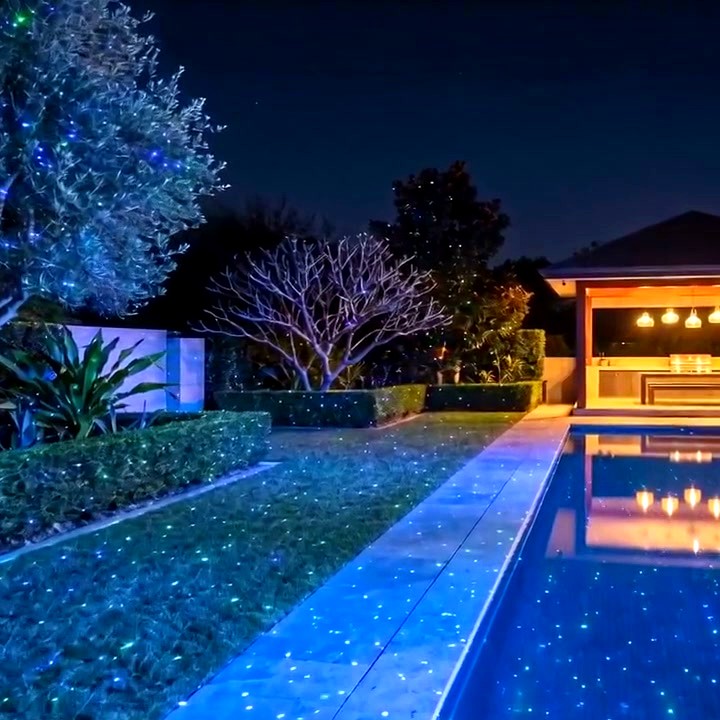
To keep this honest, here's where lasers actually sit among the other types rather than above them:
- Best coverage for the least effort, by a wide margin. Nothing else lights a whole treeline from one plug.
- Festoons still win for warm dinner-table ambience. Laser stars are a backdrop, not a light you eat by.
- Path lights still own safety. A laser is decorative; it won't light your steps.
Most people end up layering: laser stars across the trees and fence as the backdrop, something warm over the table. For parties, that combination is very hard to beat.
The one we sell is the HighBright™ Garden Laser, currently $275, down from $349. It's exactly the setup described above: mains-powered, IP65, green and blue stars with wide coverage from a ground stake. It sits at 4.9 stars across 287 Australian reviews and is running in more than 10,000 Australian homes. The store behind it is Australian-owned with stock held in QLD, and every unit carries a 12-month Australian warranty.
A quick note on indoors
Star projectors aren't garden-only. If it's a lounge room or bedroom ceiling you'd rather cover, the White Star Crystal fills a ceiling with drifting white stars, and the Aurora Laser Star Light adds soft aurora-style colour waves behind them. Same idea, indoor scale.
Quick comparison: which light does what
Here's the whole market on one screen. "Effort" covers both installation and upkeep.
| Type | Effort | Coverage | Vibe | Running cost |
|---|---|---|---|---|
| Spotlights | Moderate: stakes or wiring | One feature per fitting | Dramatic, gallery-style | Low |
| Floodlights | Moderate: often needs an electrician | Wide wash | Practical, security-first | Low to moderate |
| Pathway and bollard lights | Moderate: multiple units to place | Paths and garden edges | Neat, welcoming | Low |
| Festoon and string lights | High: anchor points and a ladder | Wherever you string them | Warm, festive, long-lunch | Low |
| Solar stake lights | Very low: push into soil | Small pools of light | Soft accents | Nothing |
| Underwater lights | High: sealed install in water | Water features only | Calm, glowy | Low |
| Laser projector | Very low: one stake, one plug | Whole treeline or yard face | Starry, festive backdrop | Low |
Choosing fixtures that last
Materials and weather sealing
Australian conditions are rough on outdoor gear: harsh UV, heat, coastal salt air and the occasional sideways storm. Cheap fittings corrode, their seals fail, water gets in and that's that. Look for powder-coated aluminium, stainless steel (marine grade if you're near the coast) or copper and brass, which weather into a nice patina instead of rusting. Lenses should be tempered glass or thick polycarbonate.
The IP rating on the box tells you where a light can live. IP44 handles splashes, fine under a covered patio. IP65 is sealed against dust and driving rain, so it can sit fully exposed all year. IP68 is submersible, which is what ponds need. Buying one rating higher than you strictly need is cheap insurance.
Bulbs and brightness
LED is the default now for good reason: long life, barely any heat, and running costs low enough to leave lights on all evening without thinking about it. Shop by lumens rather than watts. Roughly 100 to 200 lumens suits path fittings, 300 to 600 suits feature spotlights. For colour temperature, warm white between 2700K and 3000K flatters plants, timber and people; save the cooler 4000K-plus beams for security areas. If a light will shine on a seating area, dimmable is worth the small extra spend.
Matching your garden's style
Fittings should agree with the garden. Sleek black or stainless suits a modern landscape; lanterns, warm brass and copper suit cottage gardens and older homes. Pick two or three fixture styles at most and repeat them, rather than collecting one of everything. And remember that at night the goal is to notice the effect, not the hardware: the best-lit gardens hide their fittings in beds and foliage.
Placement and installation
Plan before you buy
Walk the yard on a dark evening with a torch and audition your garden. Shine it up your best tree, across the stone wall, along the path, and see what deserves permanent light. Note where power is, then sketch a rough map: paths get low soft light, one or two features get spotlights, seating gets something warm overhead. Just as important, leave deliberate dark zones. Contrast is what makes the lit parts look good; a garden lit evenly all over looks flat.
Power and wiring safety
The rule in Australia is simple: anything wired into 240V mains is a job for a licensed electrician. That's the law, not a suggestion. What you can safely do yourself is generous though: plug-in fittings running off an outdoor power point, low-voltage 12V kits fed by a plug-in transformer, battery and solar units. If you're running low-voltage cable, use outdoor-rated cable with waterproof connectors, bury it deep enough that a spade won't find it, and add up the total wattage so the transformer isn't running at its limit. And whenever you're working on anything connected, switch it off at the board first.
Placement tricks that make it look professional
A few habits separate a considered scheme from a hardware-store scatter. Uplight tree trunks from close in, so the beam climbs the bark and catches the canopy. Backlight a shrub or sculpture to throw a clean silhouette. Graze light across stone or timber at a sharp angle to bring out texture. Keep path lights low, shielded and staggered every couple of metres. Above all, keep glare out of eye lines: you should see glowing foliage and lit surfaces, never the bright source itself, and your neighbours should see none of it through their windows.
Making the most of your space after dark
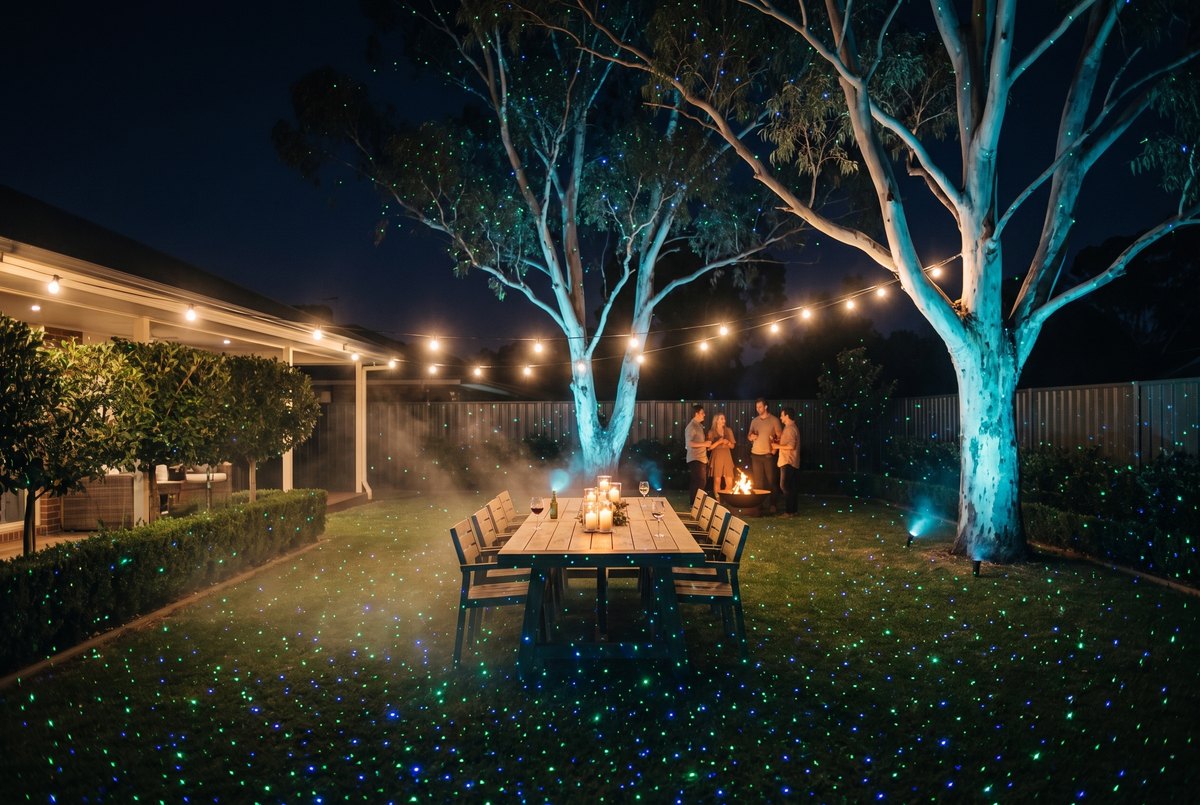
Once the basics are in, think in layers. A backdrop layer gives the yard depth: laser stars across the treeline, or festoons along the fence. A feature layer draws the eye: a spotlit tree, a glowing pond. A task layer lets people function: warm light over the table and steps. Three modest layers beat one bright blast every time.
Colour is a seasoning, not a main. Cool blues sit naturally around water and add calm; warm tones belong wherever people gather. Green and blue starfields work because they read as festive without turning the yard into a nightclub.
Smart controls tie it together. Dusk-to-dawn sensors handle the everyday, app schedules let you set scenes for dinner versus party versus away, and motion sensors keep the security layer honest. When you're on holidays, a simple schedule that varies the on-off times keeps the house looking lived-in.
Then there are the big nights. Birthdays, Christmas, New Year's Eve: this is where a layered garden earns its keep. Stars across the trees, festoons over the table, a spotlight on the best corner of the yard, and the whole place is ready for photos before anyone's arrived.
Keeping your lights in good nick
Outdoor lights are low-maintenance, not no-maintenance. A few small habits keep everything at full brightness:
- Clean lenses and solar panels a couple of times a year with warm soapy water and a soft cloth. Dust and cobwebs steal a surprising amount of output.
- Check seals, cables and connectors each season for corrosion, cracking or brittleness, and replace worn parts before water finds them.
- Act on dimming or flickering. An LED that's fading is telling you the unit or its driver is on the way out; swapping it early is easier than fault-finding later.
- Adjust with the seasons. Sunset moves a lot across the year, so nudge timers as the days shorten and stretch.
- Store seasonal sets properly. Coil string lights loosely, keep them dry in a sealed tub, and they'll come out working next year instead of tangled and dead.
- Before a big storm, bring portable fittings under cover and check that staked lights are firmly planted.
Garden lighting FAQ
Do solar garden lights work properly in winter?
Mostly, yes. Australian winters still deliver decent sun, but shorter days mean less charge, so expect reduced run times. Keep panels clean and out of shade, and buy units with reasonable battery capacity rather than the cheapest on the shelf.
Do I need an electrician for garden lighting?
Only for anything wired into 240V mains, and then it's legally required in Australia. Plug-in fittings, low-voltage 12V kits, solar and battery lights are all fair game for a DIY weekend.
What does IP65 actually mean?
The first digit rates dust protection (6 is fully dust-tight) and the second rates water (5 handles jets of water from any direction). In practice, IP65 means the unit can stay outside permanently through rain and storms. IP44 is for sheltered spots; IP68 is for underwater.
Are garden laser projectors safe?
Used as designed, yes. They sit at ground level angled up into trees and foliage, so the light lands on leaves, not eyes. The common-sense rules: never look into the aperture, don't aim the beam at windows, across open space at head height, or up into open sky, and keep it pointed at your own garden.
How bright should path lights be?
Dimmer than you think. Around 100 lumens per fitting in warm white is plenty; the aim is overlapping soft pools of light, not a landing strip. If guests can see the path and the fittings aren't glaring, you've got it right.
THE EASY STARTING POINT
HighBright™ Garden Laser
Thousands of green and blue stars across the whole garden from one plug. Mains-powered, IP65, ground stake, five-minute setup.
$275 $349
4.9 stars · 287 Australian reviews · 10,000+ Australian homes · 12-month warranty
See the HighBright →
