


Search for garden lights and the results are a wall of solar gadgets that fade by 9pm, bargain-bin fairy lights that survive one summer, and studio photos taken nowhere near a real backyard. Almost none of it answers the two questions that actually decide whether outdoor lights are worth the money: is it mains powered, and is it genuinely waterproof?
Those two filters do most of the work for you. Mains power decides brightness, reliability and whether the lights still perform in the middle of winter, when the sun clocks off at 5pm and solar panels are running on fumes. A real IP rating decides whether the lights shrug off an Australian storm or end up in the bin with fog behind the lens. This guide runs every major type of garden light through both filters, with honest notes on coverage, effort and cost, so the right pick for your yard is obvious by the end.
Jump straight to a section:
- Garden laser projectors
- Festoon lights
- Spotlights and uplights
- Path lights
- Solar garden lights
- Fairy lights
- How to read IP ratings
- Comparison table
- The verdict
- FAQ
Garden laser projectors: the most coverage for the least effort

Starting with the category that wins on sheer coverage, because nothing else in this guide comes close on ground covered per dollar, or per minute of setup. A garden laser projector sits on a spike in the lawn, plugs into a normal outdoor power point, and scatters hundreds of green and blue points of light across trees, hedges, fences and walls. One unit, one plug, and the whole backyard is lit.
The benchmark here is the HighBright garden laser projector, currently $275 down from $349. It passes both filters properly: mains powered, so it runs at full brightness from the moment the sun drops, and IP65 rated, meaning the housing is sealed against dust and low pressure water jets rather than just "splash resistant". The throw is 40 metres and beyond, which is enough to reach the gum trees on the back fence from a spike position near the house.
Effort is where lasers embarrass everything else. Setup is genuinely five minutes: push the spike into the lawn, plug in, angle the head up at the trees. No ladder, no cabling, no electrician, no weekend lost to installation. Winter reliability is excellent too, because mains power means short days and weak sun change nothing about the output.
On trust, the HighBright carries 4.9 stars across 287 Australian reviews, sold by an Australian-owned store with stock held in QLD, a 12-month warranty and 30-day returns. For a deeper dive into beam patterns, coverage maths and placement tricks, the complete garden laser buying guide covers all of it.
The honest downside: a laser projector paints an atmospheric starfield, it does not throw usable task light. Brilliant for covering the whole garden in sparkle, not the tool for lighting the barbecue plate while the snags cook.
Festoon lights: best warm ambience over a table
Festoons are the fat warm-white bulbs strung in gentle swags between posts, and over an outdoor table they are unbeatable. That golden courtyard-restaurant glow makes dinner outside feel like an occasion, and quality mains powered sets with properly rated connectors will run for years without complaint.
The catch is mounting. Festoons need anchor points: posts, a pergola, eye bolts in the fascia, ideally a stainless catenary wire so the cable is not carrying its own weight across longer spans. Plan for a proper weekend job involving a ladder, a drill and some colourful language. Once they are up, though, they are up for good.
Run them through the two filters and mains power is non-negotiable here. Solar festoons look identical in the box and disappoint everyone by June, managing a dim hour before giving up for the night. On waterproofing, check the rating on the connectors and the plug-in transformer rather than just the bulbs, because the joins between sets are where water actually gets in.
Coverage is the limitation: festoons light the zone directly underneath them and nothing else. They are the perfect finishing touch over a deck or dining table, paired with something that handles the rest of the yard.
Spotlights and uplights: best for one hero tree
An uplight at the base of a feature tree, washing light up the trunk and into the canopy, is the classic landscape designer move. It is how resorts get that sculpted, expensive look after dark, and a single well-aimed spotlight on a mature frangipani or gum can carry an entire garden bed on its own.
Now the honesty: each fitting lights one feature. Covering a full backyard this way means six to ten fittings, garden-rated cable trenched between them, and either a licensed sparky for 240V gear or a low voltage kit running off a transformer mounted near the power point. That is a real project with a real budget, paid either in weekends or on an installer's invoice.
On the filters: mains powered versions, direct or via transformer, are bright and completely winter-proof. Waterproofing matters more here than anywhere else in the garden, because ground-level fittings cop sprinklers, rain splash, mulch and the whipper snipper. Treat IP65 as the minimum, and step up to IP67 for any fitting sitting where water pools after rain.
The category verdict: superb for highlighting one or two features, heavy on effort and cost as a whole-yard solution.
Path lights: practical, not showy
Path lights are the bollards and stake lights spaced along a walkway, and their job is simple: stop guests stacking it on the step between the driveway and the front door. Judged on that job, wired versions do it well. Spaced every two to three metres, they mark a clean line of light that works every single night of the year.
Judged as garden lighting, they are modest. Each fitting throws a pool of light a metre or two wide, so they guide feet rather than light gardens. The effort is real as well, since cable has to run the full length of the path, buried or clipped out of harm's way.
One honest warning: solar path lights are arguably the most-binned garden product in Australia. They arrive bright, fade within months as the panel clouds over and the battery tires, and by mid-winter they glow about as hard as a watch face. If path lighting genuinely matters at your place, run the cable once and be done with it for a decade.
Solar garden lights: accents only, and that is fine

Time for the straight answer this category rarely gets. Solar garden lights are genuinely useful and genuinely limited, and both things are true at the same time.
The physics is the problem, not the products. A solar panel the size of a biscuit feeding a small battery cannot match a wall socket, so output is always a fraction of the mains powered equivalent. Winter doubles the punishment: shorter, cloudier days put less charge in, while longer nights ask more hours of light out. The result is the familiar July scene of solar lights managing an hour of dim glow before clocking off entirely. Expecting more is like expecting a birthday candle to heat the room.
Where solar earns its keep is decoration in places power cannot sensibly reach: crystal fairy lights woven through a garden bed, a soft glow in pots near the letterbox, gentle accents along a far fence line. The solar garden lights collection is built around exactly this kind of piece, and used this way, zero wiring and zero running cost are real advantages rather than compromises.
The rule of thumb: solar is the jewellery, never the outfit. Put mains power behind the main event and scatter solar accents where they can shine on their own terms.
Fairy lights: lovely on one tree, hard work at scale
Wrapping a tree trunk or a feature bush in fairy lights is a classic for a reason. Sets are cheap at $25 to $60, the effect reads as instantly festive, and a single wrapped tree beside the deck looks great all year round.
The hard work hides in the verbs: wrapping, unwrapping, untangling, re-wrapping after the possums have had a go. One set covers one small tree, so dressing a whole garden means many sets, several power points and an afternoon on a ladder every time something needs adjusting. Mains powered versions with outdoor-rated transformers hold their brightness all year, while solar fairy lights fade through winter like every other solar product.
There is a clever middle path: the firefly garden laser projects dozens of moving golden fireflies across beds and shrubs from one mains powered unit. The drifting, alive-looking effect lands somewhere between fairy lights and pure starfield, with nothing to wrap and nothing to untangle in August.
How to read IP ratings (before the marketing reads them for you)
"Waterproof" printed on a box means nothing by itself. The number that matters is the IP rating, and it takes thirty seconds to decode. IP is followed by two digits: the first, 0 to 6, scores protection against solids like dust; the second, 0 to 8, scores protection against water.
- IP44: protected against splashes from any direction. Fine under a covered pergola, marginal out in the open.
- IP65: fully sealed against dust and protected against low pressure water jets from any direction. This is the sensible minimum for anything living uncovered in an Australian garden, and it is the difference between genuinely sealed and splash-proof marketing.
- IP67 and IP68: protected against temporary or continuous immersion. Pond and in-ground territory.
Two traps to watch. First, "weatherproof" or "weather resistant" with no IP number attached is a vibe, not a specification, so treat it as unrated. Second, the rating applies to the fitting itself, while plugs and joins are usually the weak point. Keep connections off the ground, loop cables so water drips away from the join rather than into it, and plug into a proper weatherproof outdoor outlet on an RCD circuit.
Every garden light type at a glance
| Type | Coverage | Effort | Winter reliability | Typical cost |
|---|---|---|---|---|
| Laser projector (mains) | Whole yard, 40m+ from one unit | Five minutes, no tools | Excellent | $200 to $350 |
| Festoon lights (mains) | One zone, 10 to 20m runs | Weekend job, mounting required | Excellent | $80 to $300 |
| Spotlights and uplights | One feature per fitting | Cabling, often an installer | Excellent | $60 to $150 per light, plus install |
| Path lights (wired) | Walkways only | Cable run along the path | Excellent | $30 to $80 per light |
| Solar lights (all styles) | Small accents | None, stake and forget | Poor | $20 to $130 |
| Fairy lights (mains) | One tree or bush per set | Wrapping and untangling | Good | $25 to $60 per set |
Costs are typical Australian retail in 2026. Installation for wired systems is extra.
The verdict
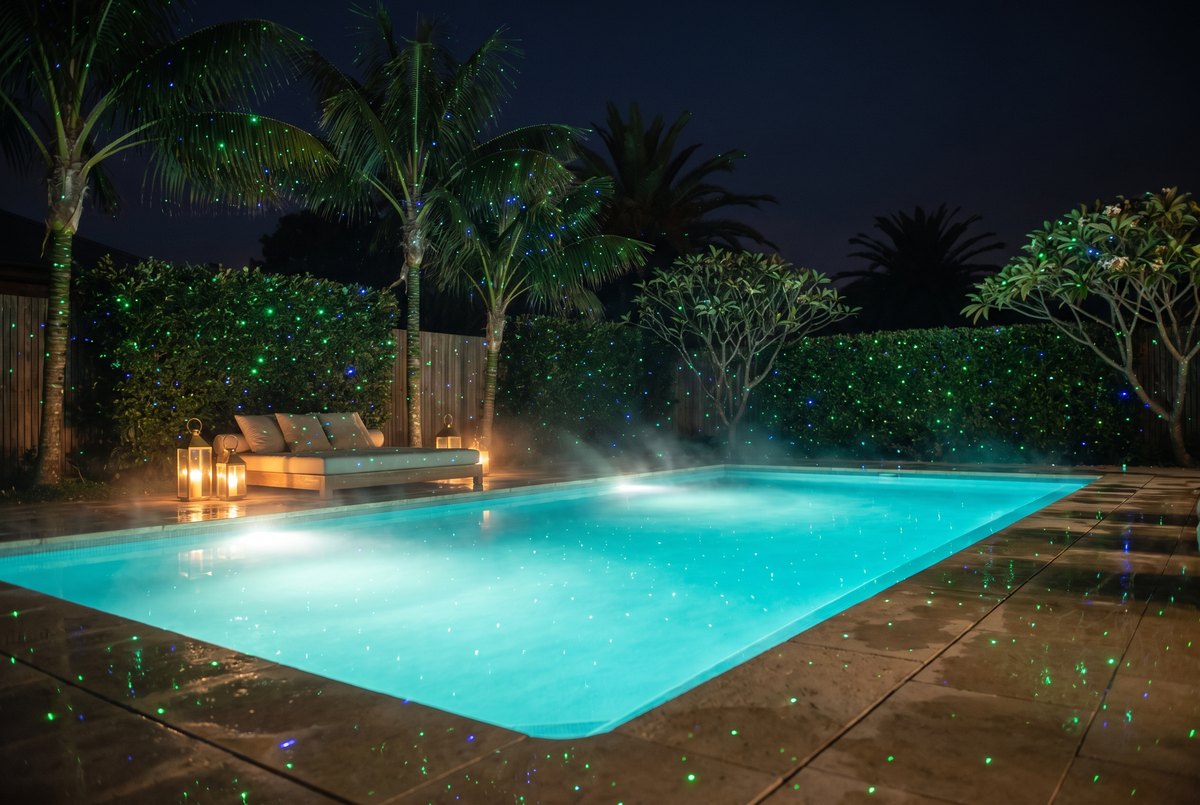
Best overall for coverage per effort: a mains powered laser projector. One IP65 unit covers more garden than a dozen wired fittings, for a fraction of the cost and none of the installation. The HighBright at $275 is the strongest pick in the category on the two filters this guide cares about: mains brightness that ignores winter, and a sealed IP65 housing that ignores storms.
Best ambience: festoons. Nothing matches warm bulbs swagged over a table for making people want to stay outside another hour. Accept the mounting weekend, buy a quality mains powered set once, and enjoy it for years.
The honest combo for most yards: a laser projector covering the whole garden, festoons over the entertaining area, and a few solar accents tucked into beds where cables cannot go. That trio handles roughly every backyard scenario for well under the cost of a professionally wired system. For a broader primer on planning zones and layering light, the comprehensive guide to garden lights is worth a read next.
FAQ
Are mains powered garden lights safe in the rain?
Yes, provided the fitting carries a genuine IP rating (IP65 for anything out in the open), the plug lives in a weatherproof outdoor outlet, and the circuit has an RCD, which is standard in Australian homes. The fitting itself is rarely the problem; exposed joins and indoor power boards dragged outside are.
What does IP65 actually mean?
The 6 means totally sealed against dust, and the 5 means protected against low pressure water jets from any direction. In practice, an IP65 light handles storms, sprinklers and a hose-down, which is why it is the benchmark rating for uncovered Australian gardens.
Are solar garden lights any good in winter?
As accents, yes. As main lighting, no. Short overcast days put less charge into the battery while longer nights demand more from it, so output drops exactly when the lights are wanted most. Keep solar for decorative touches and put mains power behind anything that has to perform in July.
How much garden does one laser projector cover?
A quality mains powered unit like the HighBright throws 40 metres and beyond, which blankets an average Australian backyard from a single spike position. Aim it across the longest diagonal of the yard to spread green and blue stars over the maximum number of trees, hedges and surfaces.
Do garden lasers cost much to run?
No. A laser projector draws less power than a typical household light globe, so an evening of full-yard stars costs a few cents. Even paired with LED festoons, the whole setup uses less electricity than one old halogen floodlight.
The 2026 pick
HighBright Garden Laser Light Projector
Mains powered, IP65 sealed, 40m+ throw. Green and blue stars across the whole yard from one five-minute setup.
$275 $349 · 4.9 stars from 287 Australian reviews · Australian-owned with QLD stock · 12-month warranty · 30-day returns

