


Shopping for a star projector turns into a vocabulary test fast. One listing says galaxy projector, the next says night sky projector, a third promises a planetarium projector experience, and the photos all look suspiciously similar. Different products, or the same thing wearing four different names? Mostly the second one.
Here is the short version: nearly every galaxy projector, space projector and aurora light on the market is built from just two lighting technologies. Learn to spot them and the jargon melts away, the dodgy listings become obvious, and picking the right unit for a bedroom takes minutes instead of hours.
This guide decodes the labels in plain English, matches each setup to the rooms it genuinely suits, runs through the checks worth making before spending a cent, and compares three Australian-stocked units at the end.
In this guide:
- The labels decoded
- Pick by use: match the projector to the room
- What to check before buying
- The three units side by side
- Galaxy and star projector FAQ
The labels decoded
Every projector in this category throws light at a dark ceiling. The only question that matters is how, and there are two answers.
Technology one: laser pinpoint stars
A low-powered laser fires through a holographic lens and splits into hundreds of tiny, sharp dots. Each dot holds its shape from one side of the ceiling to the other, and most units drift the whole field slowly so it shifts and twinkles overhead. This is the technology that makes visitors stop mid-sentence, because the points read as actual stars rather than coloured light. Laser stars usually come in green, the colour the human eye picks up most easily, or in pure white on premium crystal units.
Technology two: the LED nebula cloud
A separate LED shines through a diffusion layer and produces a soft, slowly moving wash of colour across part of the ceiling, usually blue or violet. It has no fine detail at all. Think coloured mist rather than anything a telescope would recognise. On its own it works as mood lighting; paired with laser stars it becomes the backdrop that makes the stars pop.
With those two in mind, the shelf labels sort themselves out:
- Star projector: usually stars only, no cloud. The better ones use a laser; the cheap ones push soft LED dots that look more like fuzzy blobs than stars.
- Galaxy projector: laser stars plus the nebula cloud running together. This is the combination most buyers are actually picturing when they search.
- Night sky projector, space projector, planetarium projector: interchangeable catch-alls for the same two setups above. A genuine planetarium projector that maps accurate constellations does exist as a niche gadget, but the listings borrowing that word for a bedroom light are almost never selling one.
- Aurora light: a marketing name for the nebula cloud, sold on its own or with stars scattered over the top.
And one claim to treat with suspicion everywhere: no consumer projector produces sweeping, multi-coloured aurora ribbons curling across the ceiling like the real southern lights. Not at $50, not at $500. Product photos showing that are renders, not photographs. What an aurora projector actually gives you is the soft drifting cloud described above, which is genuinely lovely to live with; it just is not the Aurora Australis. There is a full honest aurora guide on that exact subject for anyone who wants the deep dive.
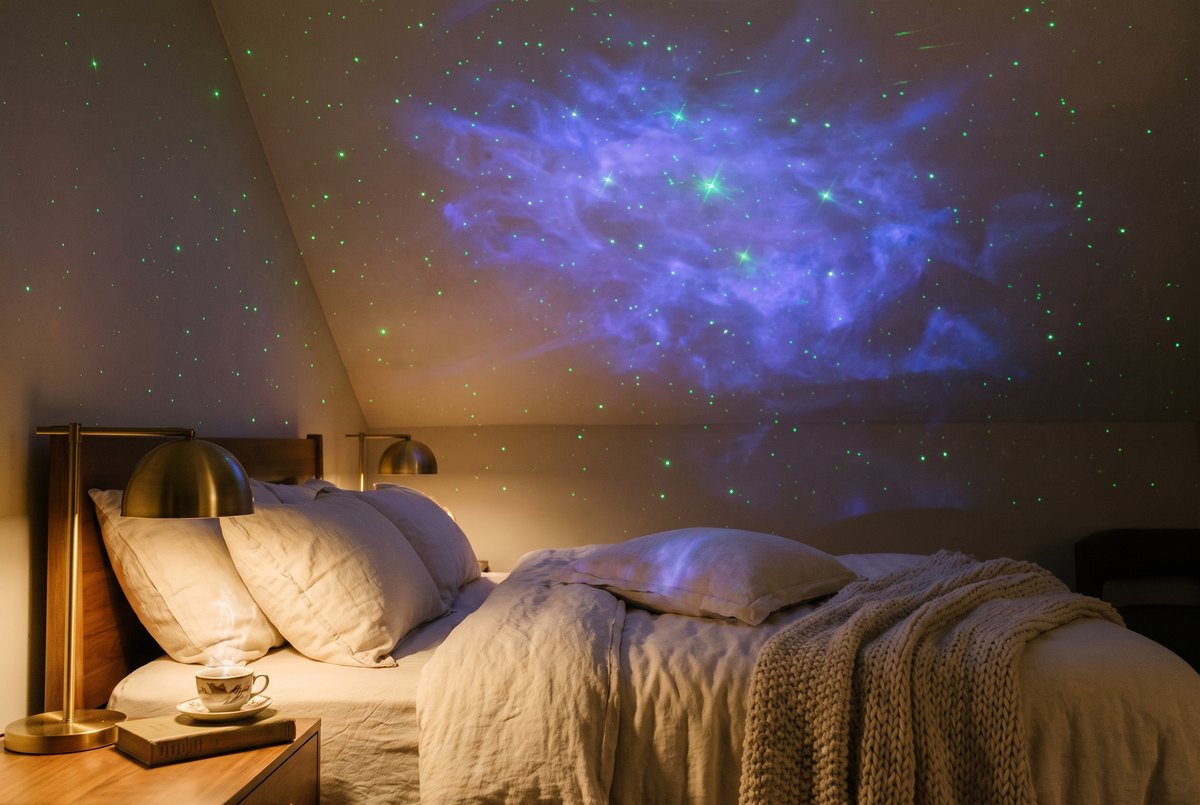
That photo shows the unedited effect: green laser stars over a blue nebula cloud. Sharp dots, soft backdrop. Every honest galaxy projector photo looks like some version of this.
Pick by use: match the projector to the room
Spec sheets matter less than the job the light has to do. Five common jobs, and what suits each one.
Kids' bedtime
The job here is a calm night light that ends the day rather than extending it. Three things matter most: gentle output, near-silent running, and a timer so the unit switches itself off once the room is asleep. Skip anything with a booming built-in speaker, party strobe modes, or an app a seven-year-old can discover and reprogram. A soft stars-and-nebula combo gives the bedtime routine a familiar, fixed end point that kids genuinely look forward to. The Laser Stars Projector ($177) is the natural fit: an indoor galaxy night light with sharp laser stars over a gentle nebula cloud, at the friendliest price of the three units in this guide.
Teen rooms and the social feed look
The ceiling teens ask for is the one all over their feeds: dense stars scattered across a glowing blue-violet cloud, filmed in the dark on a phone. By the definitions above, that is a galaxy projector, and the closer the stars are to true laser pinpoints, the better the footage turns out, because phone cameras latch onto sharp light sources far more cleanly than onto soft LED blobs. The Aurora Laser Star Light ($245, down from $319) produces exactly that scene: crisp green laser stars over one deep blue-violet nebula cloud. What the ceiling shows is what the camera gets, no filter required.
Master bedroom wind-down
The job: replace a harsh overhead globe with something slow and low-stimulation for the last hour of the day. Colour does the heavy lifting. Blues and violets sit at the calm end of the spectrum, and a drifting nebula with a scatter of stars gives tired eyes something soft to rest on while the day winds off. The Aurora Laser Star Light earns its spot here too, with one honest caveat worth repeating: it runs a single blue-violet cloud, not a rotating rainbow. For a wind-down room, that restraint is precisely why it works.
Movie and media rooms
The job: atmosphere that does not fight the screen. A rich coloured cloud looks brilliant during music nights and background ambience, but it can wash the wall behind a TV mid-film. Two sensible paths: keep a galaxy unit like the Laser Stars Projector in a lounge that doubles as a media room, or go pure white pinpoints for a dedicated theatre space, since white starlight reads as cinema-ceiling atmosphere rather than a second light show competing for attention. Multi-purpose lounges lean galaxy; serious theatre rooms lean white.
The pure white minimalist option
Some rooms, and some people, simply do not want coloured light. Styled master bedrooms, dining areas, coastal-neutral interiors: a green starfield can feel out of place against all that careful restraint. The White Star Crystal Laser ($297, down from $449) exists for exactly this buyer. Pure white pinpoint stars, no nebula, no colour anywhere, and it is built for indoor and outdoor use, so the same unit covers the bedroom ceiling one night and the alfresco area or a dinner party the next. This is the quiet-luxury end of the category.
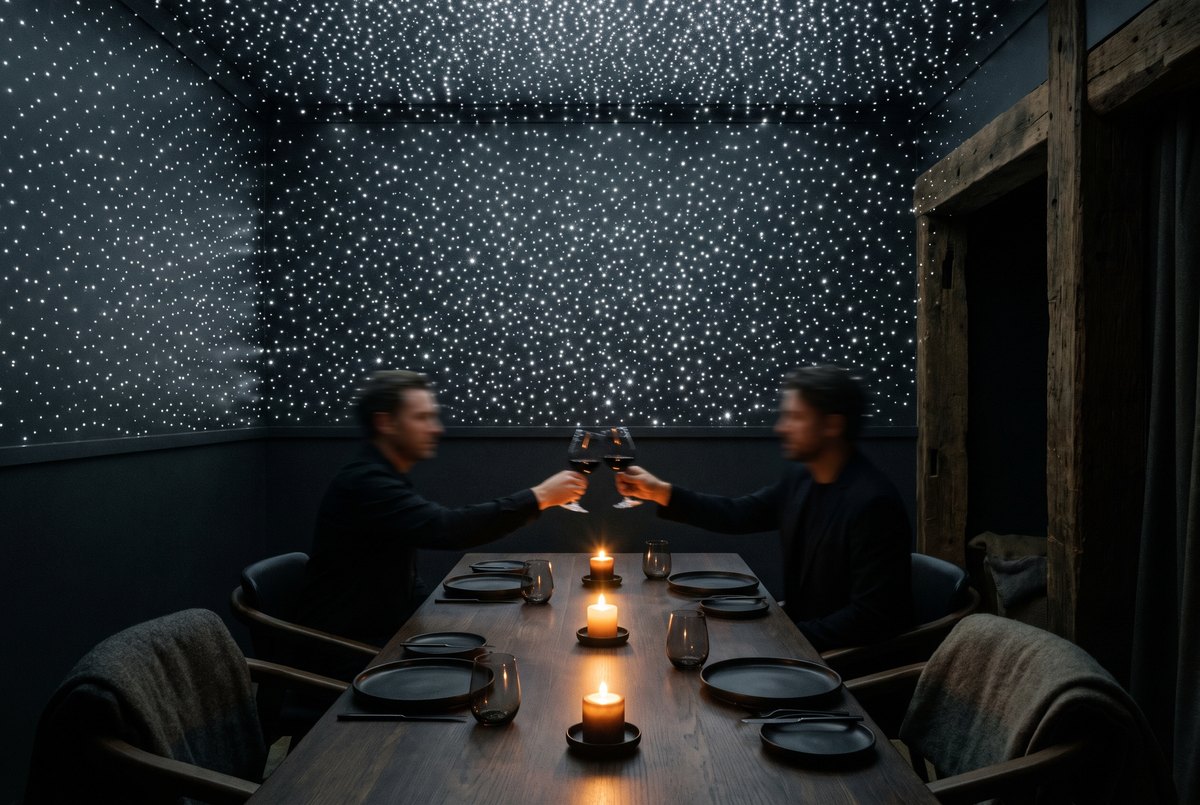
Pure white pinpoints over a dinner table. Same core technology, entirely different mood.
What to check before buying
Five checks separate the keepers from the returns pile, whatever the label on the box says.
- Laser stars or LED stars? Laser points stay sharp and focused across the whole ceiling; LED "stars" are soft-edged dots that blur towards the corners. Listings rarely admit which is which, so study the untouched customer photos. Crisp pinpoints mean laser.
- Noise. Plenty of cheap units cool themselves with a small, whiny fan, which defeats the entire purpose in a bedroom. Anything marketed for sleep should run close to silent, and reviews mention fan noise very quickly when it exists.
- A proper timer. An auto-off timer is non-negotiable for kids' rooms and very handy for adults who nod off under the stars. No timer means the projector runs until somebody wakes at 3am to deal with it.
- Nebula size and honesty. Check how much ceiling the cloud actually covers and how many colours appear at once. One cloud in one colour family is normal and looks great in a dark room. A photo showing the entire ceiling wrapped in swirling rainbow ribbons has been edited, per the aurora point above.
- No-app simplicity. A physical remote outlives any app. Companion apps get abandoned by their developers, demand accounts, and turn bedtime into a wifi-pairing exercise. Unless a feature genuinely needs an app, simpler wins.
One more thing worth weighing: where the stock sits and who answers when something plays up. The three units in this guide are stocked in Queensland and carry a 12-month warranty with 30-day returns, which is a very different safety net from a nameless marketplace import.
The three units side by side
Three projectors, three different jobs. Prices in Australian dollars.
| Unit | Effect | Best room | Price |
|---|---|---|---|
| Laser Stars Projector | Laser stars + nebula cloud (indoor) | Kids' rooms, lounges | $177 |
| The Aurora Laser Star Light | Green laser stars + one blue-violet nebula | Teen rooms, master bedrooms | $245 |
| White Star Crystal Laser | Pure white pinpoint stars only (indoor/outdoor) | Styled bedrooms, dining, theatre rooms | $297 |
Galaxy and star projector FAQ
Is a galaxy projector the same as a star projector?
Not quite. A star projector usually throws stars only. A galaxy projector adds the LED nebula cloud behind the stars, which is the look most people picture when they search. Night sky projector, space projector and planetarium projector are generally the same two setups wearing different names, so judge by the photos, not the title.
Do aurora projectors show real southern lights ribbons?
No, and any listing suggesting so is using edited images. Consumer aurora lights produce a soft drifting cloud of colour, not moving multi-coloured ribbons dancing across the ceiling. The cloud effect is still well worth having; it just deserves an honest description before money changes hands.
Are laser star projectors suitable for kids' rooms?
The bedroom units covered here use low-powered lasers spread through a lens into hundreds of faint points, so no single dot carries a concentrated beam. Sensible habits still apply: keep the unit out of small hands' reach, teach kids never to stare into the lens itself, and use the timer so it switches off after lights out.
Do these projectors need an app or wifi?
None of the three units above needs an app, an account or a wifi connection; everything runs from a basic remote out of the box. As a general buying rule, treat app-only control as a red flag on any bedroom device, because the app tends to die long before the hardware does.
Can a star projector be used outdoors?
Only if it is built for it. The White Star Crystal Laser is rated for indoor and outdoor use, so it moves happily between a bedroom ceiling and a patio wall. The Laser Stars Projector is an indoor unit. Whatever the brand, never leave an indoor-only projector anywhere near weather.
The pick for most bedrooms
The Aurora Laser Star Light: crisp green laser stars over one deep blue-violet nebula cloud. No app, no fuss, just the ceiling everyone films.
$245 $319
4.9 stars · 287 Australian reviews · QLD stock · 12-month warranty · 30-day returns

